
The Tradwife Is a Performance About Money
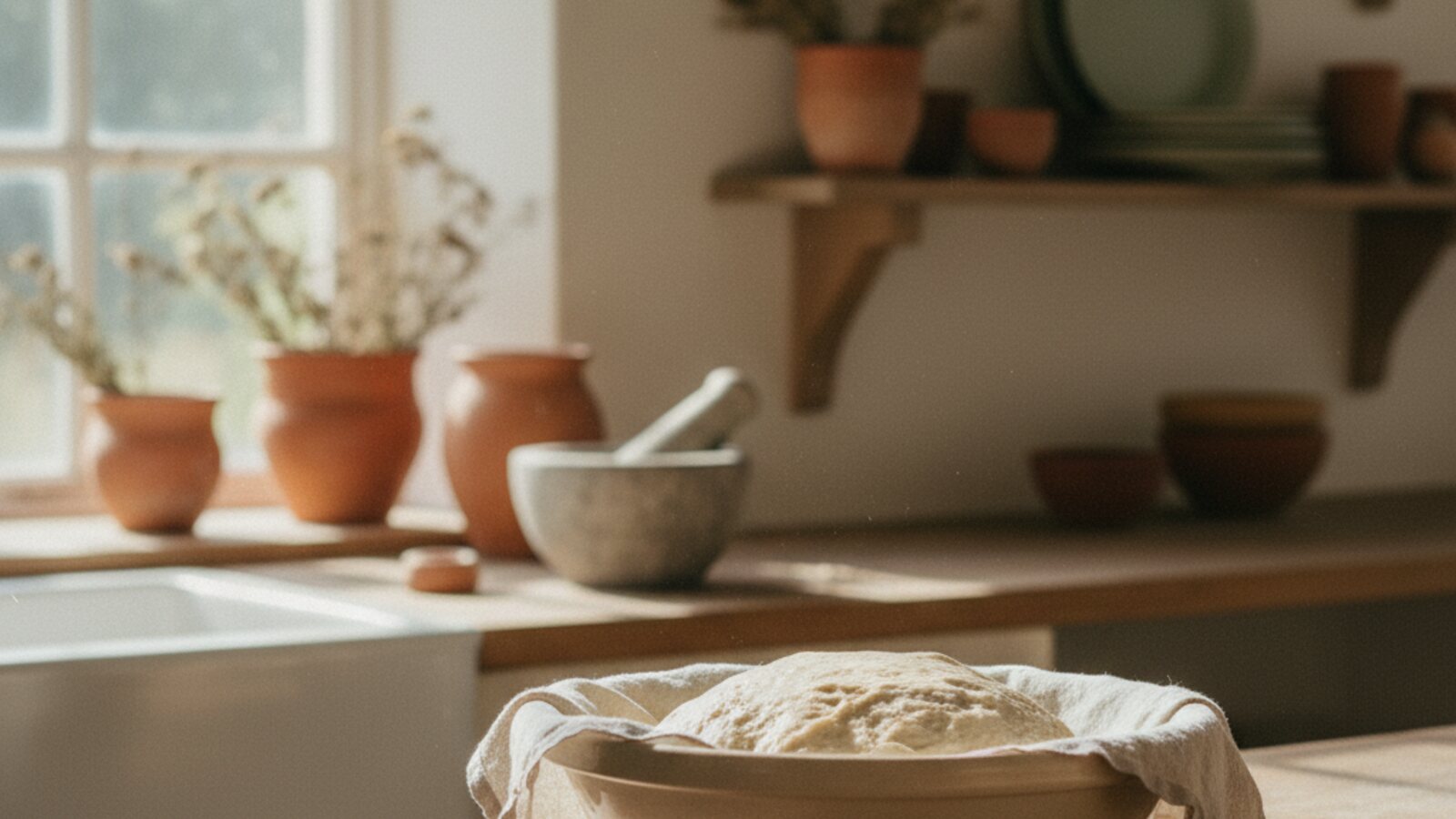
She is making bread again. The light is doing that thing where it falls through the kitchen window like it was hired. Her children are barefoot and nobody is crying, and her dress is linen, and the dough rises in a bowl that costs more than your first car payment, and somewhere under the flour and the fiddle music a caption tells you she chose a simpler life.
You watch the whole thing. You are not proud of this. You have a meeting in nine minutes and a toddler who considers pants a betrayal, and you watch a stranger fold dough for ninety seconds and feel something you can’t quite name.
Let’s name it. But first, let’s talk about the bread.
The dress is linen. The rent is invisible.
Here is the question the video never answers: who is paying for the kitchen?
Not rhetorically. Actually. The land, the light, the Le Creuset. The children’s clothes that are somehow always cream-colored and never stained. A household is an economic unit, it has always been an economic unit, and the video works precisely because the economics have been edited out. What’s left is a life where money is ambient, like the fiddle music. It arrives from nowhere and asks nothing.
No woman in history has actually lived there.
The video, meanwhile, is itself a job. A good one. The camera was set up by someone. The light was found, the take was chosen, the caption was written, the sponsorship was negotiated. The woman telling you she left the workforce is, in the most literal sense, at work right now, in a growing content economy where the performance of not working pays real money. There’s nothing scandalous about that. It might be the most honest part of the whole thing. She has a job; the job is the fantasy; the fantasy is for you.
Which means the interesting question was never “is she for real.” The interesting question is why ninety seconds of someone else’s slow morning does something to your chest.
The tradition is younger than your grandmother
Because here’s the part the aesthetic skips: the “traditional” household it references barely existed.
For nearly all of human history, wives worked, visibly, centrally, economically. The farm wife ran a production operation: dairy, garden, poultry, cloth, food preservation on a scale that decided whether the family made it to spring. The shopkeeper’s wife kept the books. The weaver’s wife wove. Households were businesses, and women were not accessories to them but engines inside them. Nobody in 1850 filmed the butter churn in golden light, because everybody understood the butter was revenue.
The arrangement the tradwife feed calls timeless, one man at an office, one woman at home with no economic role except consumption, describes roughly the two decades after World War II, in a handful of wealthy countries, for the slice of families who could afford it. It was a blip. A postwar, single-earner, suburban blip, and even inside the blip, reality kept leaking: at the model’s supposed heyday in 1950, one in three American women was in the labor force, by the government’s own count. Plenty of women worked anyway, because plenty of families needed them to.
So the feed isn’t showing you tradition. It’s showing you a costume drama about a very short historical episode, staged in a kitchen that today’s economics make almost impossible, funded by the very platform economy it claims to have escaped.
And you still can’t stop watching it. Neither can a few million other smart, tired people. That’s the part worth taking seriously.
The longing is the real content
Strip the linen and the lore and look at what the video is actually selling, and it’s not the 1950s and it’s not bread.
It’s an unhurried morning. It’s attention that lands in one place instead of shattering across nine apps and a calendar. It’s the sense that your hands are doing something that will still matter at dinnertime. It’s presence, time, and a life where the people you love get the best hours instead of the leftovers.
That longing is not embarrassing. That longing is correct. You were built for mornings like that, and you live in an economy that strip-mines them. The tradwife feed found the wound with impressive precision. Its answer is the costume. The wound is real either way.
And this is where it matters that there are women who actually did choose home, on purpose, with their eyes open, and they’ll be the first to tell you the feed is fiction. Ask a woman who left a career she was good at to run a household of small children, not for the camera but for the life, and she will laugh, warmly, at the linen dress. She’ll tell you the work is real work, the way an ICU shift is real work: triage, logistics, repetition, love under load. Choosing it deliberately is a serious ambition, and it deserves better than being flattened into an aesthetic where the labor disappears and someone else’s money hums in the background like a refrigerator. The staged version doesn’t honor that choice. It erases the very thing that makes it substantial.
So the costume fails coming and going. It tells the working mother she’s one linen dress away from peace, and it tells the home-by-choice mother that her actual, muscular, unphotogenic work is a mood board. Nobody in the frame is getting told the truth.
Take the longing. Skip the cosplay.
Here’s the move, and it costs nothing: separate what the video makes you feel from what it tells you to buy.
The feeling is information. It’s telling you which hours of your life feel strip-mined and which feel like yours. That’s worth knowing. That’s worth acting on, in this century, in your actual house. The unhurried hour exists on both sides of the employment line; it was never about the sourdough. Women found it on farms between milkings and find it now between meetings, and the finding has always been deliberate, because no era hands it over for free.
What the video tells you to buy is a time machine. Don’t. Not because staying home is wrong and not because working is wrong, Gaux has never believed either, but because the choice was never actually between a spreadsheet and a wheat field. It’s between letting an algorithm tell you what your longing means, and reading it yourself.
You don’t have to choose a century. You get to keep the career and the slow morning, the ambition and the bread, if you want all of it, or home and the whole of your mind, if that’s the life you’re building on purpose. The women in your corner of the world are already doing both, unfilmed, in kitchens with ordinary light.
The dough doesn’t care who’s watching. That was always the best thing about it.
Continue with the Family Journal and Gaux classes.
Walk this window with our experts.
Gaux experts teach small-group classes with real Q&A and replays included.
See the classesDr. Mona
Dr. Monateaches on Gaux, where experts share what they’ve learned from real practice with families.
Get expert advice in your inbox. No spam. No noise.
Fewer, better emails.