
Sleep Deprivation Is a Body Story Nobody Tells Straight
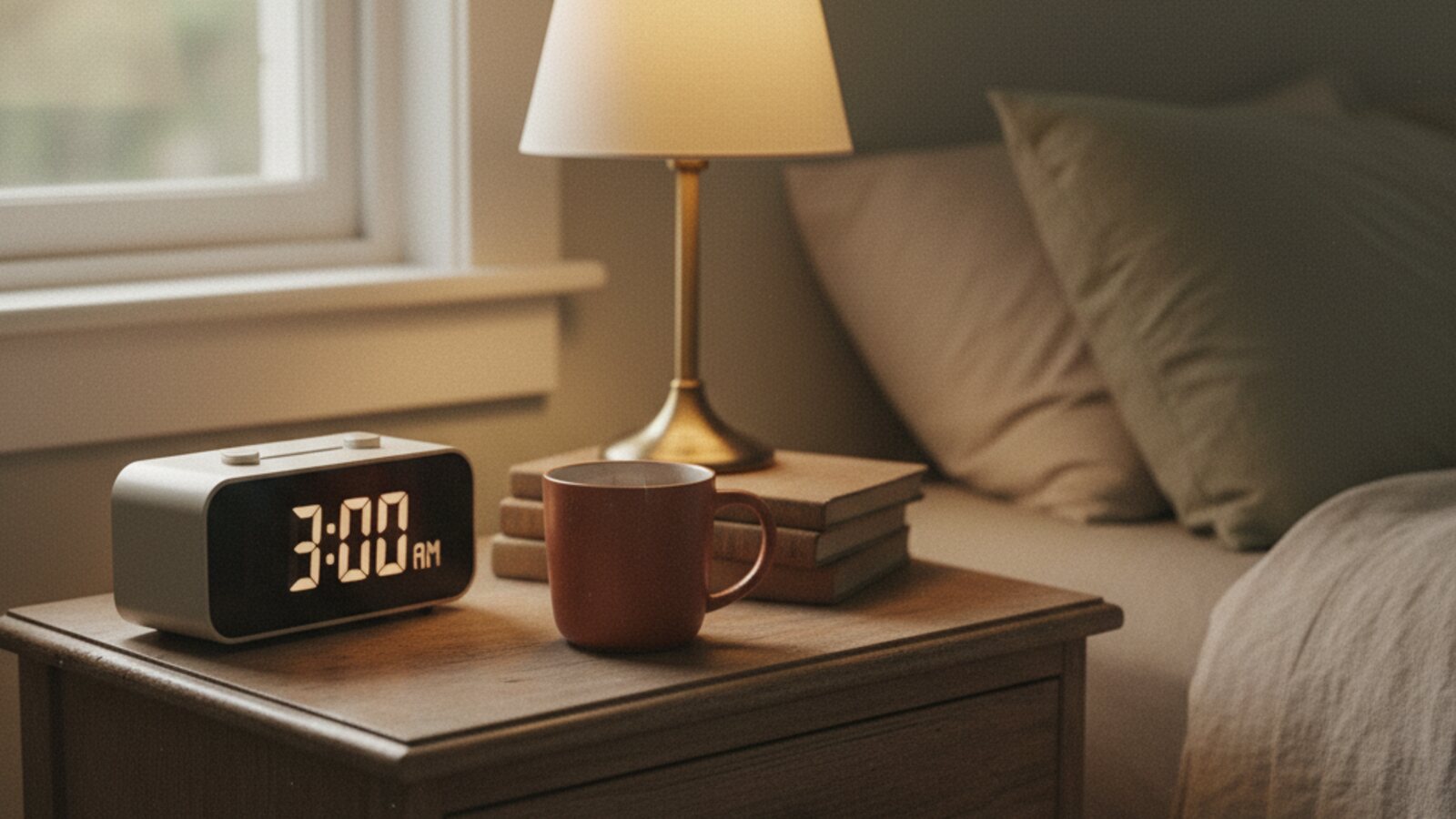
It is four in the morning and the world has ended. Not loudly. Quietly, the way it always ends at four in the morning, with a certainty that has nothing to prove because it feels like the floor of things. Every worry you have ever had is standing in the room in a line, oldest first. The baby is finally asleep on your chest and you cannot move and you would not be able to stop the thoughts anyway. This is the truest hour, you think. This is what things actually are.
And then it is seven, and there is coffee, and the same worries have to knock to get in. The floor of things turns out to have been a trick of the light. Or a trick of the dark, which is worse, because you believed it.
Nobody tells you that the despair has a schedule. So let’s tell it straight.
What the body is actually doing at 4 a.m.
Start with the fact that broken sleep is not the same as short sleep, and it is worse. You can get, on paper, a survivable number of hours and still feel scraped hollow, because sleep that is chopped into ninety-minute pieces never lets the deep and dreaming stages do their overnight work. That work is not optional. The sleeping brain is where emotional memory gets filed and where the day’s sharp edges get sanded down, and the dreaming stage in particular is heavily involved in processing feeling. Take it away in fragments, night after night, and the machinery that keeps your reactions proportionate starts to slip.
Here is the slip, in plain terms. Sleep loss turns up the volume on the brain’s alarm center and weakens the circuit that is supposed to talk it down. The amygdala, the part that flags threat, becomes more reactive, and its connection to the prefrontal regulator frays. So a minor thing lands like a major thing. Irritability rises, negative feeling sharpens, and the mind tilts toward the aversive reading of whatever is in front of it. Research also tracks the obvious: the longer you go without adequate sleep, the more people report anger, anxiety, sadness, confusion, and stress. None of that is weakness. It is neurology under load.
Now add the clock. Your body runs a daily temperature rhythm, and it bottoms out in the small hours, around dawn. Mood rides that rhythm. The pre-dawn trough is a known low point, which is exactly why the 4 a.m. thoughts feel geological and the 8 a.m. version of the same thoughts feels like a to-do list. The despair is real as an experience and unreliable as a witness. It is your circadian floor, not your actual future, and it tends to lift with the light. Knowing that does not switch it off. It does downgrade it from prophecy to weather.
“Sleep when the baby sleeps” is a meme, not a plan
Which brings us to the advice everyone gives and no one can use.
Sleep when the baby sleeps is a lovely sentence that assumes the baby sleeps on a schedule a human adult can dock onto, that nothing else needs doing in those windows, that you can fall asleep on command in twenty-minute increments, and that the laundry and the eating and the being a person all happen in some other dimension. It treats a structural problem, too little continuous sleep and too few hands, as a personal scheduling failure. It puts the fix inside one exhausted body and calls it a plan. It is not a plan. It is a slogan wearing a plan’s clothes, and it has made a lot of tired people feel like the tiredness is their fault.
The real problem is not that you are bad at napping. The real problem is that one nervous system is being asked to run a twenty-four-hour operation on a battery built for eight, alone, with a poster on the wall telling it to try harder.
What people did before the poster
History is more useful here than any tip, and it starts with a strange fact: the unbroken eight-hour night may itself be a fairly recent invention.
The historian Roger Ekirch spent years in old diaries, court records, and letters and found thousands of references, across many languages and going back to the ancient world, to something called first sleep and second sleep. People went down not long after dark, slept for a stretch, woke for an hour or two around midnight, and then had a second sleep until morning. The waking middle was not a problem to be fixed. It was a room in the night. People prayed in it, talked, tended fires, made love, thought. Ekirch’s argument is that the consolidated eight-hour block we now treat as natural was shaped by the industrial world, by powerful artificial light above all, and by a new economic pressure to compress rest into one efficient slab so the rest of the hours could be sold.
Honesty requires a footnote here, because scholars disagree about how universal that pattern really was. When researchers measured sleep in three present-day societies without electricity, the Hadza, the San, and the Tsimané, they found people sleeping in one main consolidated stretch of roughly six or seven hours, not two neat halves, which complicates any claim that segmented sleep is simply the human default. The safe version of the history is the interesting one: the specific eight-hour, do-it-alone, all-in-one-block ideal that new parents measure themselves against is not a law of nature. It is a cultural arrangement, and a young one, and you are failing to meet a standard that itself has a birthday.
The other half of the history is the part the slogan erased entirely. Rest, historically, was engineered by people, not willed by one person. Across dozens of cultures the weeks after a birth came with a name and a structure, la cuarentena, zuo yuezi, omugwo, the lying-in month, and the structure was built on kin. Mothers, aunts, sisters, and neighbors took shifts. Someone else held the baby so the new mother could get an unbroken stretch. Nobody expected a single depleted body to be the whole night crew, because everybody understood that a body cannot be. The traditions were not soft. They were load-bearing sleep architecture made of other humans.
That is the plan the poster forgot. Not try harder. More hands.
The line that isn’t just tired
One clear thing, because exhaustion and illness can wear the same face at 4 a.m.
Ordinary sleep-deprived despair lifts. It follows the clock down before dawn and back up with the light, and the daytime version is smaller than the nighttime one. When it stops lifting, that is different. When the low sits on you through the mornings too, when the intrusive thoughts sharpen, when you cannot sleep even in the windows when the baby finally does, when the color has been gone from things for weeks rather than hours, that is not a willpower problem and not a hands problem. It is a medical one, common and treatable, and it is worth one phone call. Postpartum Support International is at 1-833-TLC-MAMA.
The floor is not the future
So take the small hours less literally. The despair at 4 a.m. is a real feeling produced by a body doing hard biology at its lowest ebb, and it is a genuinely unreliable narrator about your life. The fix was never a better attitude toward napping. It was, and still is, more hands and a truer story: you are not built to be the whole night crew, no one ever was, and getting help is not a shortcut around the work. It is the work, done the way humans have always actually done it.
The floor of the night is not the shape of your days. Wait for the light. It comes.
Inside Gaux there are people awake at your hour, in a room where nobody performs and somebody always answers. Come find them when you want to.
Continue with the Family Journal and Gaux classes.
Walk this window with our experts.
Gaux experts teach small-group classes with real Q&A and replays included.
See the classesDr. Mona
Dr. Monateaches on Gaux, where experts share what they’ve learned from real practice with families.
Get expert advice in your inbox. No spam. No noise.
Fewer, better emails.