
The Grandmother Hypothesis
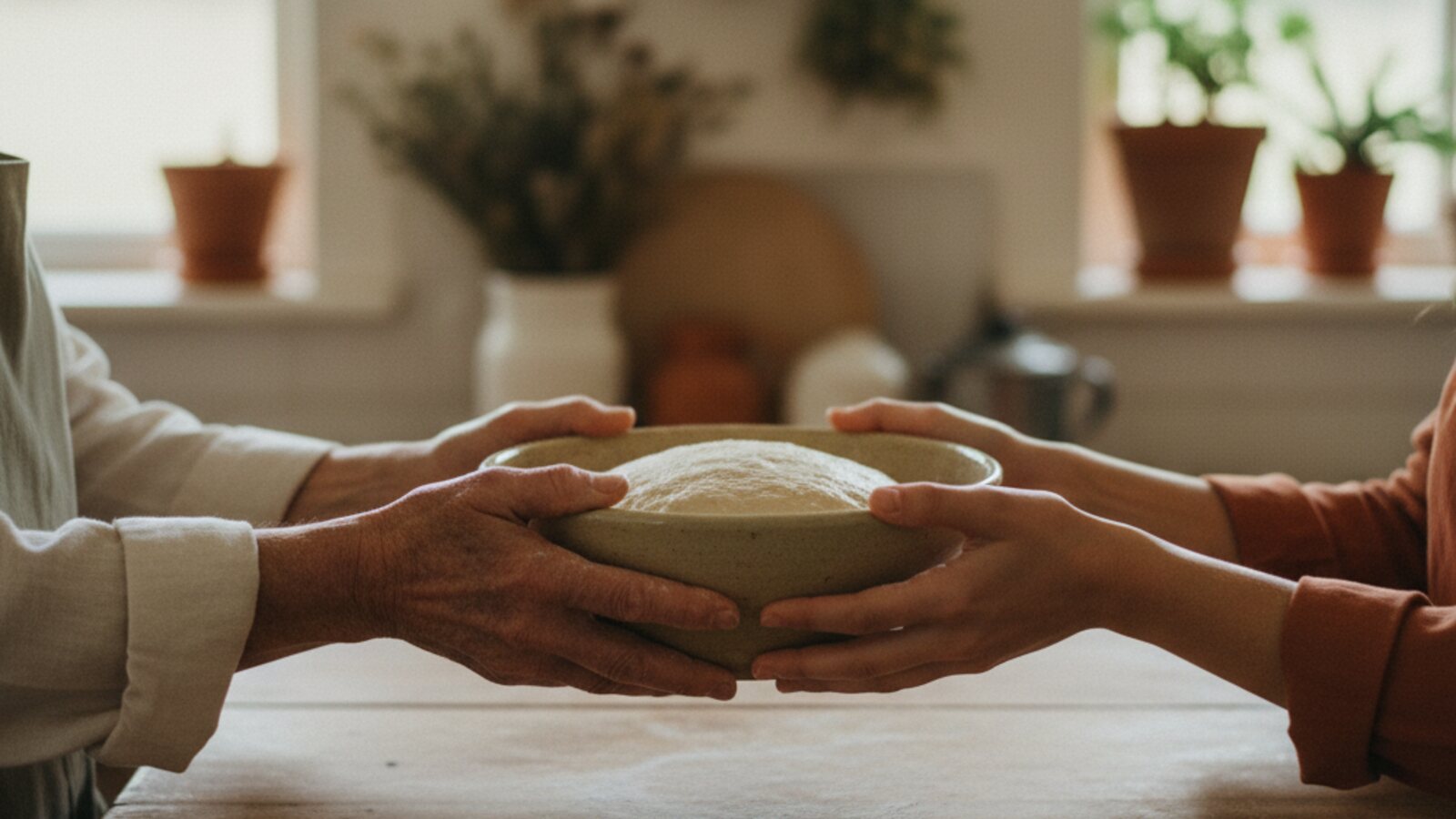
Somewhere in northern Tanzania, in the dry season, a woman in her sixties is doing the hardest job at the camp. She is not resting. She is bent over a digging stick in the hard ground, working a deep root loose from the earth, a tuber buried too far down for a child to reach. She will do this for hours. Then she will carry it back and feed it, most of it, to a grandchild who is not yet good at feeding himself.
Kristen Hawkes went to study how hunter-gatherers hunt. She is an anthropologist at the University of Utah, and she went to the Hadza expecting the story to be about men and meat, the way the story usually is. What she could not stop noticing instead were the old women. They were out-foraging everyone. They were the most productive people in the camp, and almost none of what they gathered was for themselves.
That observation turned into a question that reaches all the way down into what a human being is. And the question starts with something no one ever explains.
The thing evolution isn’t supposed to allow
Here is the strange fact at the center of this. Almost no animal outlives its own fertility for long.
For most species, the arithmetic of evolution is blunt. A body exists to pass on its genes, and once it can no longer reproduce, natural selection more or less stops maintaining it. The lioness, the chimpanzee, the elephant: reproduction and life tend to end at roughly the same time. To keep a body running for decades after it can have no more offspring is, from evolution’s cold accounting, a puzzle. It costs food and effort and returns no babies. It should have been selected away.
And yet here we are. Human women routinely live thirty, forty, fifty years past their last pregnancy, in good health, sharp, strong enough to dig. This is not a modern artifact of hospitals and vitamins. It shows up in forager societies with no medicine at all. Long post-reproductive life is not a bonus feature of civilization. It looks like part of the original human design.
Outside of us, this is almost unheard of. Menopause with a long, vigorous life after it is documented in humans and in a small handful of toothed whales: killer whales, narwhals, belugas, and two kinds of pilot whale. That is close to the entire list on Earth. Female killer whales can live into their eighties while the males are mostly gone by forty. Something unusual is going on in these species, and the whales and the humans seem to have arrived at it separately, which is its own quiet clue.
So the puzzle stands. Why would a species build a body to keep going long after it stops making babies? Hawkes’s answer was standing right in front of her with a digging stick.
The math of a grandmother
The idea is sometimes credited in seed form to the biologist George Williams back in 1957, but it was Hawkes and her colleagues who gave it teeth, and the teeth came from the Hadza.
Here is the logic. A young human child is a strange, long project. Human babies are weaned relatively early but stay helpless for years, unable to gather the tough, buried, processed foods that adults eat. A chimpanzee that age feeds itself. A human that age cannot. So a mother of a young child is trapped by a bottleneck: she cannot easily go have another baby while she is still hand-feeding the last one.
Unless someone else feeds the older child.
Enter the grandmother. If an older woman, past her own childbearing, spends her days doing exactly what Hawkes watched the Hadza women do, pulling up the deep tubers a small child can’t manage and handing them over, then the mother is freed. She can wean sooner. She can have her next baby sooner without the older child going hungry. The grandmother’s help turns directly into more surviving grandchildren, which is to say, into more copies of the grandmother’s own long-life genes carried forward.
And that is the turn that dissolves the puzzle. A woman who lived long and stayed strong past menopause was not a drain on the group. She was a multiplier. The genes for a durable, useful, long-lived body got passed down through all those extra grandchildren she made possible. Longevity paid for itself, one dug root at a time.
There is even historical arithmetic to put behind it. A study of centuries-old church records from Finland and Canada found that women who lived on past their fertility, with grandchildren nearby, ended up with more grandchildren surviving to adulthood, roughly the equivalent of two additional grandchildren for a woman who lived well past sixty. The effect was strongest when the grandmother was still young enough to be genuinely useful. Being there, and being able, was the whole thing.
What the hypothesis is, and honestly, what it isn’t
Here is where an honest essay slows down, because the grandmother hypothesis is a leading idea, not a closed case, and treating it as settled would be its own kind of disrespect to how science works.
It is one of the strongest explanations we have for human longevity, and it has held up across decades of testing. But it competes with others. Some researchers favor a “mother hypothesis,” in which stopping fertility earlier protects a woman from the rising danger of late-life childbirth so she can finish raising the children she already has. Others point to a “patriarch” account tied to men’s long fertility. And the grandmother effect that shows up so cleanly in humans has been harder to find in some other species and some other datasets, which tells you the mechanism is real but not universal, and probably not the only force at work. The most careful reading is that grandmothering is one powerful factor among several that shaped the strange, long human life, not the single lever that explains all of it.
That the case isn’t closed is not a weakness. It is the shape of a real question still being answered. And it doesn’t touch the part that matters most, which was never really about the arithmetic.
Text your mother
Because underneath the tubers and the church records is a plain, warm claim about what human beings are.
We are not built to raise children alone. We were never built to raise children alone. The very length of a human life, that long tail of decades after fertility that no cold accounting can explain, may exist precisely because someone older stayed close and helped. The grandmother was not a bystander to human evolution. She may have been one of its authors. The reason you get to hold your grandmother’s hand at all, this theory says, is that grandmothers holding grandchildren changed the species’ math.
Which means the woman who raised you, or her mother, or the one who dug the roots, was doing something that shows up not just in your childhood but arguably in your very lifespan. That is a large debt and a strange, lovely one. It is also easy to pay a little of it back.
She is probably reachable in about four seconds. You know the one.
Continue with the Family Journal and Gaux classes.
Walk this window with our experts.
Gaux experts teach small-group classes with real Q&A and replays included.
See the classesDr. Mona
Dr. Monateaches on Gaux, where experts share what they’ve learned from real practice with families.
Get expert advice in your inbox. No spam. No noise.
Fewer, better emails.