
“Enrichment” Is a Word Invented to Sell You Something
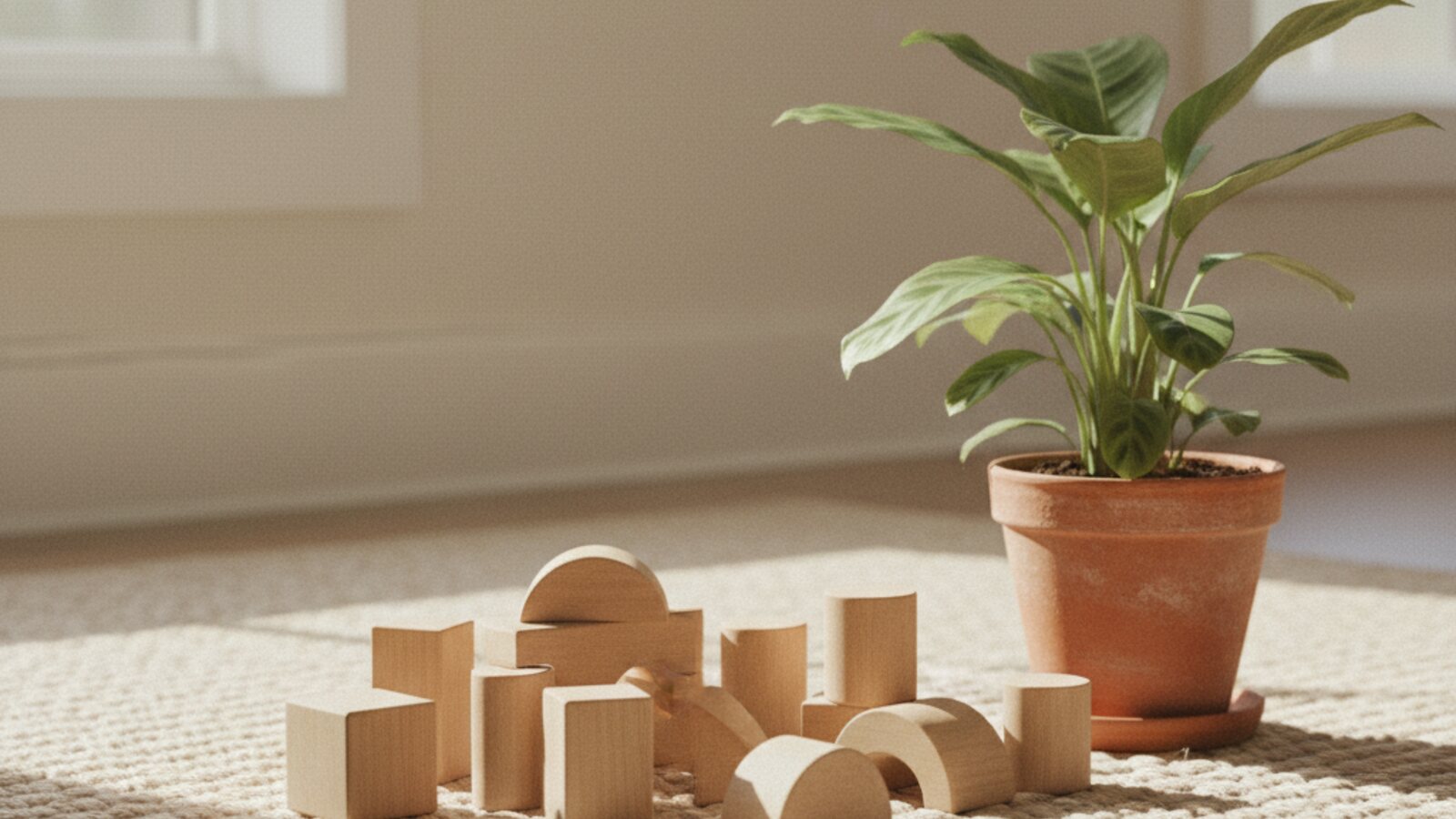
There is a flyer on the coffee-shop corkboard, and it is speaking directly to your worst three a.m. self. Baby Signing. Toddler Music Discovery. Little Linguists, ages eighteen months and up. The photography is warm. The word at the top, in a font that costs money, is Enrichment. And you stand there holding a lukewarm oat-milk something, doing the math on whether forty dollars a week for a class your toddler will experience as “a room with a tambourine” is the difference between a thriving child and one you have somehow, at two, already failed.
Put the pen down. Not because the class is bad. The room with the tambourine might be delightful. Put the pen down because the word doing the work on that flyer was engineered, and you deserve to know by whom.
The word is doing a job
Start with the word itself, because “enrichment” is a small marvel of language. It implies a baseline that is, by contrast, impoverished. Enriched flour is flour with the nutrients added back after they were milled out. So the word quietly tells you that a normal Tuesday with your child, the walk to the mailbox, the narrated laundry, the twenty minutes he spends investigating a colander, is the stripped version. The deficient one. The class is the vitamins.
That is a sales structure, not a scientific finding. And the interesting thing about the toddler-enrichment industry is that we can name the almost exact moment the sales structure was built, and the person who stood up and called it a myth while it was still under construction.
The myth had a launch date
In the late 1990s, American parenting culture absorbed a very specific, very exciting story about the infant brain. The pitch went like this: the first three years are a sealed window. Synapses are forming at a furious rate, the window is closing, and every hour you fail to stimulate that brain is potential lost forever. It arrived with real star power. In 1997 there was a White House conference on early childhood development and a prime-time ABC special, and the culture leaned in. (White House conference and “I Am Your Child” campaign, 1997.)
Then the products came. Georgia’s governor moved in 1998 to send a classical-music recording home with every newborn in the state, on the theory that Mozart tuned the infant brain for math. (Georgia’s 1998 “Mozart for newborns” program.) A company called Baby Einstein turned flash cards in video form into a business Disney thought worth buying. The logic was always the same window, always closing, always requiring a purchase.
Here is the part the flyer will never tell you. In 1999, the cognitive scientist John Bruer wrote an entire book taking the story apart, and he titled it, with no hedging, The Myth of the First Three Years. His argument was not that early childhood doesn’t matter. It was that the neuroscience had been stretched, oversimplified, and marketed past what it could bear. Synapse counts, critical periods, “enriched environments” from rat studies: all of it had been flattened into a slogan that the science did not support. Reviewers in the actual scientific press largely agreed with him. (Bruer, The Myth of the First Three Years, 1999.)
The claims kept unraveling from there. The “Mozart effect” that launched the newborn CDs turned out to be, on close analysis, tiny and fleeting, tied to a specific paper-folding task in college students, and hard to replicate at all. The researcher whose work started it has said plainly that none of her studies showed passive listening made children smarter. (Chabris meta-analysis and Rauscher’s own clarification.) And the baby videos, sold for years as educational, ended with Disney dropping the word “educational” after a federal complaint and, in 2009, offering refunds. A University of Washington study had found that for every hour babies spent watching, they understood fewer words, not more. (Disney’s 2009 Baby Einstein refunds and the underlying research.)
None of this stopped the industry. It renamed itself. “Brain building” became “enrichment,” the window softened into a vibe, and the flyer went up on the corkboard.
What actually feeds a brain
So if the laminated curriculum was oversold, what does the research reward? The answer is almost annoyingly ordinary, and it is mostly free.
It rewards conversation, the real back-and-forth kind. In one study of four-to-six-year-olds, the number of conversational turns a child took, the actual volleys of talking with an adult and not just talk aimed at them, predicted stronger language scores and more activity in the brain’s language regions. The researchers were careful about what mattered: not dumping words into a child, but the exchange. The turn-taking. (Romeo et al., 2018, on conversational turns and brain response.) You already own the equipment for this. It is your mouth, and a child who wants your attention.
It also rewards the thing enrichment culture is most afraid of: unstructured time. In a 2014 study, researchers looked at how six-year-olds spent their days and found that children who spent more time in less-structured activities, the open-ended, self-directed kind, showed stronger self-directed executive function, the capacity to set your own goals and get yourself there. The more scheduled and adult-run the time, the weaker that particular muscle looked. This one is correlational, and it is worth saying so out loud: it shows a relationship, not proof that free time causes the gain, and the children who get more open time may differ in other ways. But it points hard in one direction, and that direction is not toward a fuller calendar. (Barker et al., 2014, correlational.)
There is even a case to be made for boredom, the empty stretch where a child, given nothing, eventually invents something. That is not neglect. That is a child running the self-direction program with no adult holding the joystick.
The permission slip
Now, the part that matters, because this is not an argument against classes.
If the toddler music hour is the highlight of your week, if it gets you out of the house, if it hands you forty-five minutes among other adults who also haven’t finished a sentence since Tuesday, that is a genuinely good reason to go. Community is worth paying for. So is an activity you both like. So is structure, on the weeks you need someone else to provide it. A class can be a joy, a lifeline, or simply fun, and none of those need to be dressed up as brain surgery to be worth the money.
What you can set down is the fear. The fear that the unpurchased Tuesday is the deficient one. It isn’t. The narrated laundry counts. The colander counts. The long walk where you name the dogs counts, and the afternoon where you name nothing and let the child get gloriously, productively bored counts too. The market has spent thirty years persuading smart parents that ordinary life is the stripped-down version and the enrichment is the vitamins. The research quietly says the opposite. The ordinary life was always the whole grain.
Buy the class because you want it. Keep the forty dollars because you don’t. Either way, the flour was never poor to begin with.
Continue with the Family Journal and Gaux classes.
Walk this window with our experts.
Gaux experts teach small-group classes with real Q&A and replays included.
See the classesDr. Mona
Dr. Monateaches on Gaux, where experts share what they’ve learned from real practice with families.
Get expert advice in your inbox. No spam. No noise.
Fewer, better emails.