
Your Child Does Not Need a Perfectly Curated Childhood
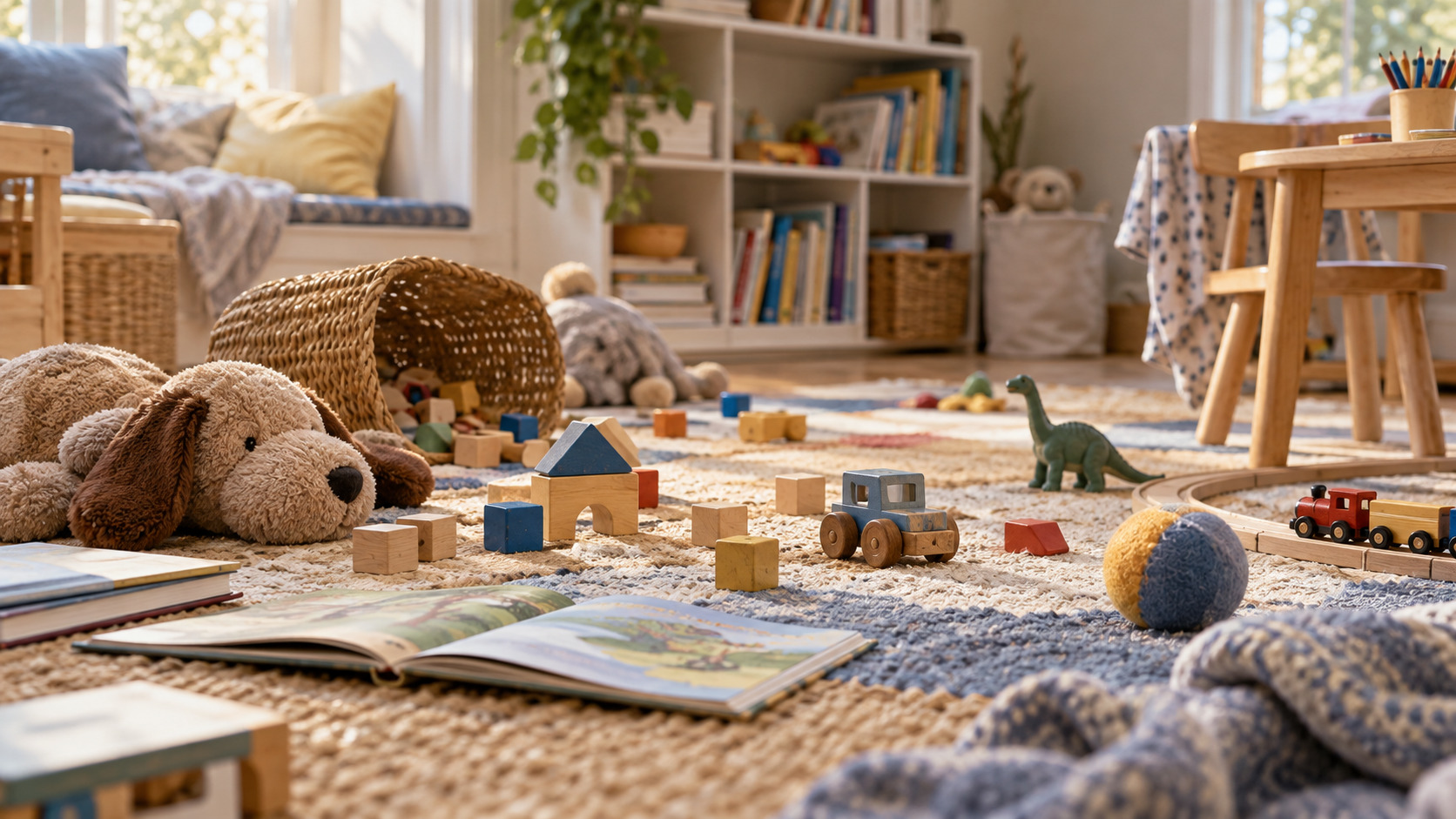
It is a Tuesday afternoon and your four-year-old is lying on the floor, narrating something to a plastic dinosaur, and you are wondering whether this counts. Not whether it is pleasant. Whether it counts. Whether somewhere across town another four-year-old is at a music class, and whether the floor is a mistake.
That question, asked often enough, turns a living room into a ledger.
The hour that has a job
There is a difference between an hour that has a job and an hour that does not, and children need both, and the second one is the one under pressure.
An hour with a job is legible. It has a name, a location, a fee, sometimes a recital. It produces something you can describe to another adult. "She does violin on Thursdays" is a sentence that answers the question, and the question is often not is my child thriving but am I doing this right.
An hour without a job is harder to defend. It looks like nothing. It is the dinosaur, the puddle, the long stretch of a child doing something with no obvious outcome, and it is where a surprising amount of development actually happens.
What play is for
In 2018 the American Academy of Pediatrics published a clinical report titled The Power of Play, and the framing was deliberately blunt: play is not frivolous.
The report describes unstructured, free play as intrinsically motivated, spontaneously chosen, and often without an external goal, and argues that this kind of play is brain-building, central to healthy development, and important for executive function. It also positions play as a buffer against toxic stress, a builder of parent-child bonds, and a driver of social, emotional, language, cognitive, and physical development. The lead authors argued that the importance of playful learning for children cannot be overemphasized.
The 2018 report also cited historical observations; these figures are not a current estimate of every child’s experience. Time for play declined substantially between 1981 and 1997. About thirty percent of kindergarten children no longer have recess. Only roughly half of children get daily outdoor playtime with a parent.
The takeaway is not that classes are bad. The takeaway is that the thing being displaced by the optimization is not empty time. It is a specific developmental input, and replacing it is harder than it looks.
Boredom is not a leak
A common worry is that unstructured time is time leaking out of a childhood that could have been fuller. The trouble with that model is what it assumes about where capability comes from.
A child who is never bored does not practice generating their own activity. A child whose every hour is scheduled does not practice choosing. The skill of finding something to do with an empty afternoon is a skill, and it is built the way skills are built, which is badly at first and then better.
This does not mean the empty afternoon is sacred and every class is a compromise. It means the empty afternoon has a function that is easy to mistake for absence.
The optimization tax on you
There is a second cost, and it lands on the adult.
A curated childhood is a second job. It requires research, scheduling, driving, and a running mental ledger of who is signed up for what and whether it is the right thing. Parents who run this program often report the same thing: they are exhausted, and they cannot identify the moment they chose it.
The pressures are real. Comparative information is more available than it has ever been, and the standard of comparison is usually other people's edited highlights. But the load is also optional in ways it does not feel, and it is worth asking whether the schedule you are maintaining is one you would defend in a calm conversation, or one you inherited from a feed.
The permission slip
Here is the plain version.
Your child's development is not a competition with the children of strangers, and you are not behind, because there is no schedule to be behind on. The research does not describe a childhood optimized hour by hour. It describes attention, responsiveness, safety, play, and time with people who like them.
The dinosaur on the floor counts. The puddle counts. The hour with no name and no fee counts, and it has value alongside organized activities.
The floor was never the mistake.
---
Related reading: Explore Gaux family learning in the Family Journal, and Gaux classes on play and development.
Sources and further reading
- Yogman, M., Garner, A., Hutchinson, J., Hirsh-Pasek, K., and Golinkoff, R.M., "The Power of Play: A Pediatric Role in Enhancing Development in Young Children," Pediatrics 142(3):e20182058 (2018), American Academy of Pediatrics Clinical Report. Read source
- American Academy of Pediatrics, The Power of Play: How Fun and Games Help Children Thrive, HealthyChildren.org. Read source
Continue with the Family Journal and Gaux classes.
Walk this window with our experts.
Gaux experts teach small-group classes with real Q&A and replays included.
See the classesGaux Team
Gaux Teamteaches on Gaux, where experts share what they’ve learned from real practice with families.
Get expert advice in your inbox. No spam. No noise.
Fewer, better emails.