
What Babies Borrow From the People Around Them
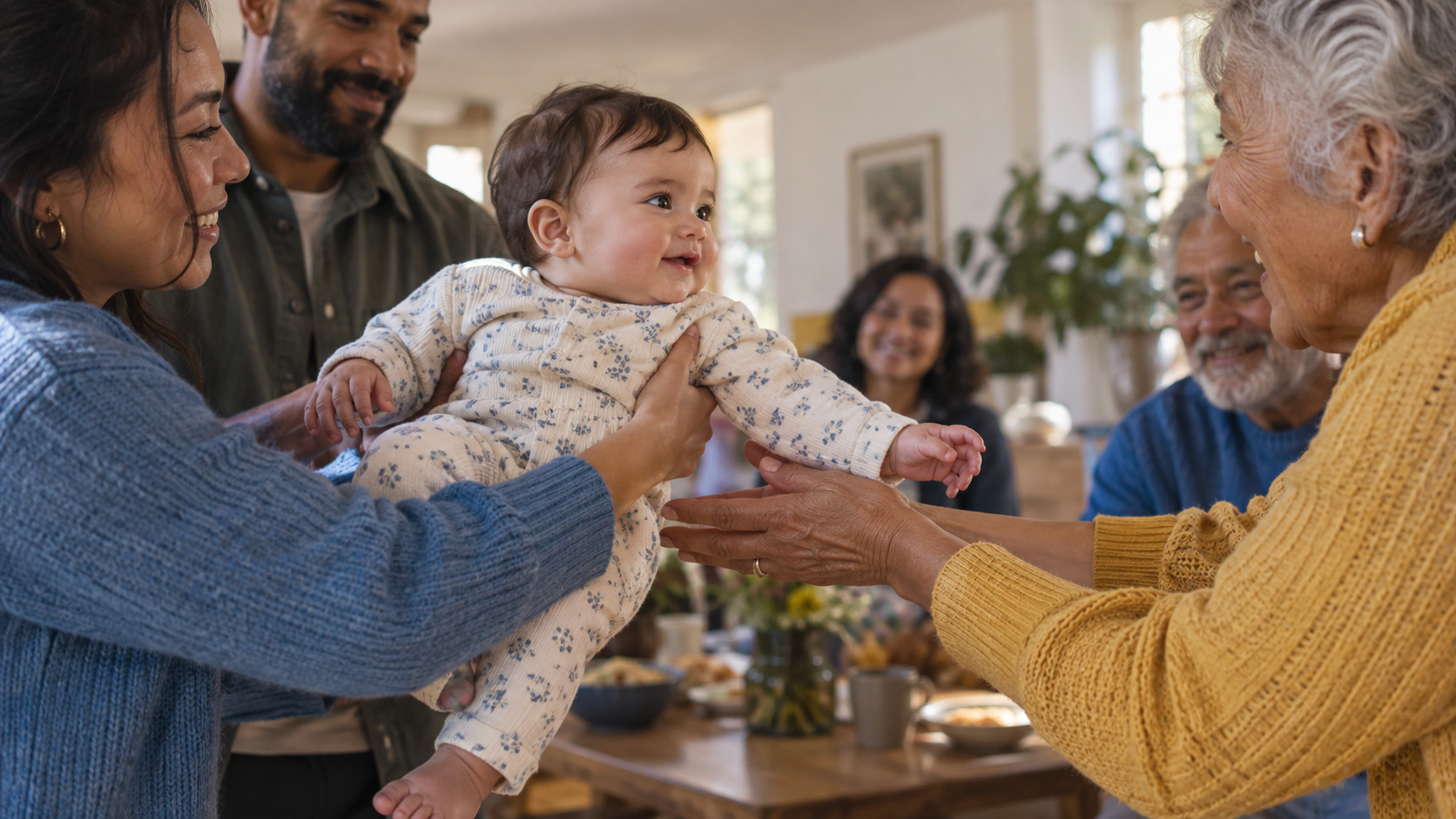
There is a moment at a family gathering when the baby is passed from one set of arms to another and something shifts in the room. The crying stops. The shoulders drop. Nobody did anything particularly skillful. The baby simply borrowed a different adult's nervous system for a while.
Borrowing is a metaphor for support from another person, not a literal transfer of a nervous system.
The circle is not a ranking
Infants’ regulation develops over time, and they rely heavily on responsive caregivers. The help comes from outside, and it comes from more than one person.
This is what researchers mean when they describe humans as cooperative breeders. Unlike most primates, human infants are typically cared for by multiple adults, not just the mother. Across cultures and across history, the set of people who hold, feed, carry, and calm a baby has usually been wider than the pair who made them. Grandmothers are the most studied example, but they are not the only one.
The circle is not a ranking of who matters most. It is a distribution system.
What the research actually shows
The grandmother hypothesis, associated with anthropologist Kristen Hawkes, proposes that human longevity after menopause evolved partly because older women increased their own reproductive success by helping feed and care for grandchildren rather than continuing to bear children. Her work with Hadza hunter-gatherer populations found that grandmothers had measurable effects on their grandchildren's survival and nutrition, and her modeling work argued that grandmothering could substantially extend lifespan in a population over time.
It is worth adding the caveat, because it is a real one and because the honest version of the story is more interesting than the tidy one. The strength and universality of grandmother effects are actively debated. Some analyses of natural fertility populations find the evidence weak or inconsistent, and the finding that maternal grandmothers help in one population does not always replicate. Cooperative breeding is best understood as a tendency with substantial variation, not a law.
Which is the useful part for a modern parent. If the mechanism matters and the exact cast does not, then the question is not do I have a grandmother nearby. It is is anyone besides me helping regulate this baby.
Borrowed regulation
Developmental work uses co-regulation to describe how people support one another’s regulation. A familiar, responsive caregiver can help a baby settle, although a calm adult will not stop every episode of crying.
A capable adult who can respond to the baby’s needs is useful support. Techniques, feeding, comfort, and the circumstances can all matter; no adult’s emotional state is a guaranteed solution.
Another familiar, capable adult can provide useful support. Which is also why the depletion of the primary caregiver matters so much, and why "someone else is already holding them" is not a failure of your care. It is the system working.
Why "it takes a village" gets misread
The proverb has been flattened into "you should have more friends." That is not the finding.
What the research describes is a wider set of caregivers, which historically often meant kin, older children, neighbors, and community members with a defined role. Those roles were specific and reciprocal: this person watches the children while you work, you contribute food, this other person teaches the older one, you help with the harvest. The obligation ran in both directions and was understood by everyone involved.
Modern versions often keep the expectation of help without the structure that made it reciprocal, which is why "find your village" can land as another task on an already full list.
Building your own version
If the mechanism is a wider circle of calming adults, then the circle can be built on purpose, and it does not need to look like a village.
It can be one reliable person who is not you, who knows the baby's cues and does not need instructions. It can be a paid professional, which counts. It can be a neighbor with a standing Tuesday. It can be a friend who is not especially good with babies but is very good at being calm and staying for two hours.
Two things make these people useful rather than decorative. They need enough contact with the baby to become a familiar body, which takes repetition, not just one visit. And they need to be trusted with actual decisions, so that the baby is genuinely in their care and not in your care while you hover.
The baby will not be able to tell you what they borrowed. But you will notice it in your own shoulders.
---
Related reading: Find a Gaux class for your season in Gaux classes, and more on the care circle in the Family Journal.
Sources and further reading
- Hawkes, K., O'Connell, J.F., Blurton Jones, N.G., Alvarez, H., and Charnov, E.L., "Grandmothering, menopause, and the evolution of human life histories," Proceedings of the National Academy of Sciences 95(3):1336-1339 (1998). Read source
- Hawkes, K., "Grandmothers and the evolution of human longevity," American Journal of Human Biology 15(3):380-400 (2003). Read source
- Strassmann, B.I. and Kurapati, N.T., "Are humans cooperative breeders? Most studies of natural fertility populations do not support the grandmother hypothesis," Behavioral and Brain Sciences 33(1):35-39 (2010). Read source
- Sear, R. and Mace, R., "Who keeps children alive? A review of the effects of kin on child survival," Evolution and Human Behavior 29(1):1-18 (2008). Read source
The grandmother hypothesis is presented with its published counterarguments; it is an area of active scientific debate and not a settled finding.
Continue with the Family Journal and Gaux classes.
Walk this window with our experts.
Gaux experts teach small-group classes with real Q&A and replays included.
See the classesGaux Team
Gaux Teamteaches on Gaux, where experts share what they’ve learned from real practice with families.
Get expert advice in your inbox. No spam. No noise.
Fewer, better emails.